Skip to content

Computation in AEC Made Simple

The Python Framework to create, connect and share interoperable computational tools for Architecture, Engineering and Construction.
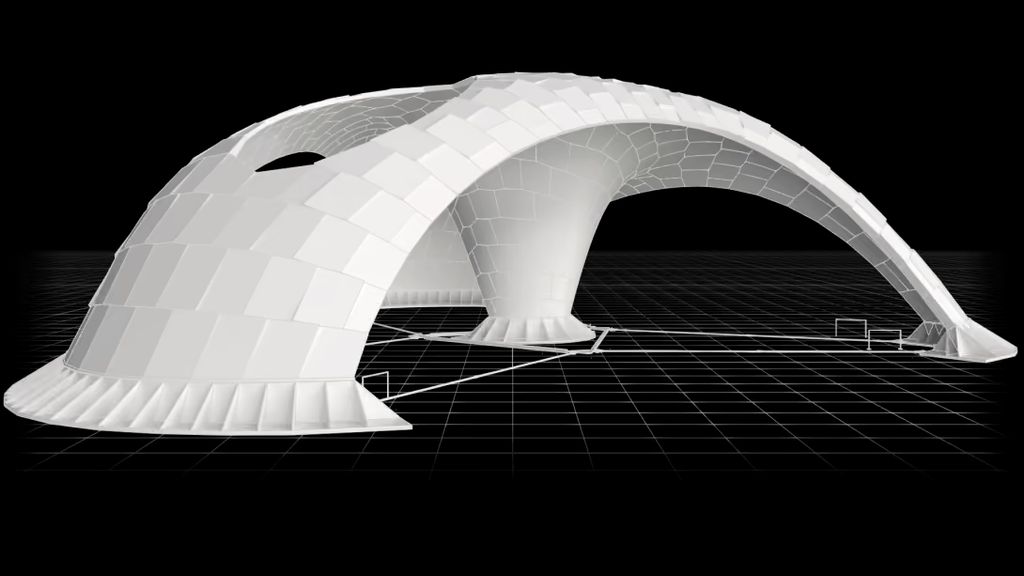
Rendered model of a segmented shell vault standing on a ground grid

Used and supported by

Features

What's in COMPAS?

A unified ecosystem of geometry, data, and tools for building computational workflows in architecture, engineering, and construction. From core data structures to cross-platform integrations, COMPAS provides the solid foundations you need to create, connect, and share advanced design and fabrication processes.
  • Robust Geometry Kernel
    Reliable, consistent primitives and operations for points, vectors, frames, curves, surfaces, meshes, volumetric meshes, breps, etc, optimized for different platforms.
  • Flexible Data Models
    A lightweight, composable system for defining custom data classes with JSON serialization and interoperability across environments.
  • Interoperability Across Tools
    Exchange geometry and data between Rhino, Grasshopper, Blender, Jupyter Notebooks, Unity, ROS/MoveIt, Revit/IFC, cadwork 3D, and more, via consistent APIs.
  • Cross Platform
    Write your logic once and run it in Python, Rhino/Grasshopper, Blender, servers, cloud pipelines, or XR applications without changing your data structures.
  • Modular Extension Ecosystem
    Official and community libraries expand COMPAS into robotics, timber, fabrication, numerics, workflows, and interoperability. Plug in only what you need!
  • Developer-Friendly Foundation
    Clear APIs, open-source code, strict naming conventions, testing utilities, and documentation designed for both research prototypes and production tools.

Use Anywhere

COMPAS is fully platform-agnostic. Write your code once and run it in your preferred environment: your CAD tool, the cloud, or the web.

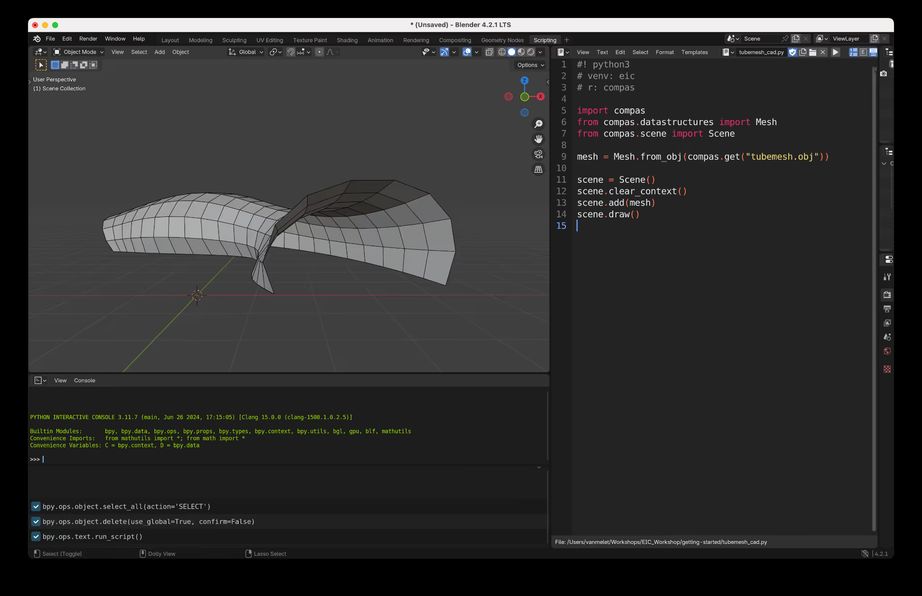
With a unified API across Rhino, Grasshopper, Blender, and Python, you stay focused on your logic, not on adapting to each tool.

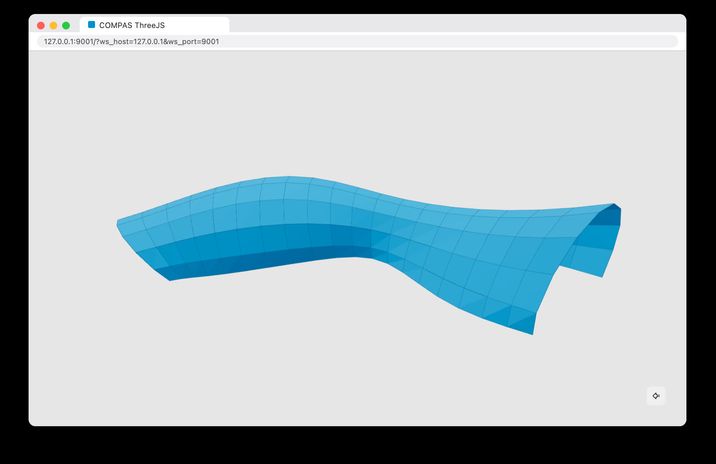
Blender with a COMPAS script in the text editor that loads a mesh and draws it in the 3D viewportThe COMPAS ThreeJS viewer in a browser window, showing the same mesh in COMPAS blue
The same mesh in Blender, and in the COMPAS ThreeJS viewer in the browser.

Made with COMPAS

Built work from the labs and practices that use COMPAS, from 3D-printed bridges to robotically assembled timber.
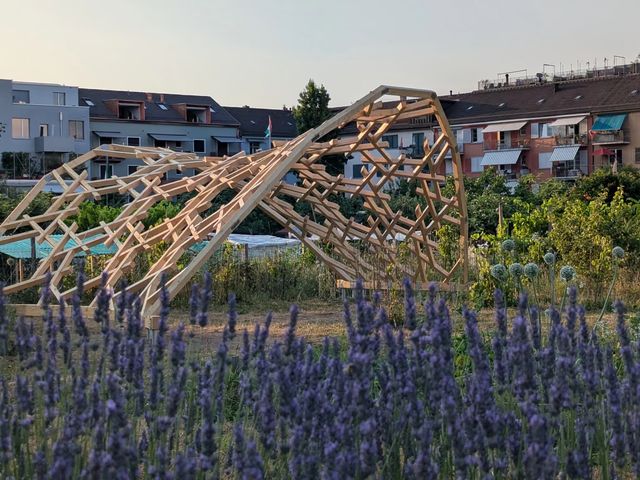
  • A leaf-shaped lattice of timber beams arching over a community garden at golden hour, with lavender in the foreground and apartment buildings behind

    HARDLEAF

    Quartiergarten Hard, Zürich, Switzerland · 2026

    A leaf-shaped timber pavilion of 182 beams for a neighbourhood garden, designed and built by students, with kiwi plants growing over it for shade.

    Coding Architecture II, Gramazio Kohler Research, ETH Zurich · Photo: lisdem
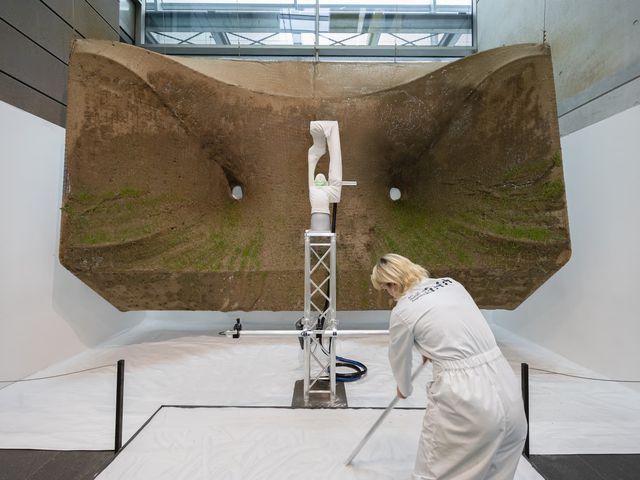
  • A robot arm on a truss in front of a large suspended net sprayed with soil and sprouting grass, while a person in a white overall draws in sand

    Sybil

    Ars Electronica, Linz, Austria · 2026

    Visitors draw in sand, and a robot turns their traces into toolpaths, spraying soil and seeds onto a suspended net that grows into a living surface.

    Architecture and Human Augmentation, ETH Zurich · Photo: Zita Oberwalder

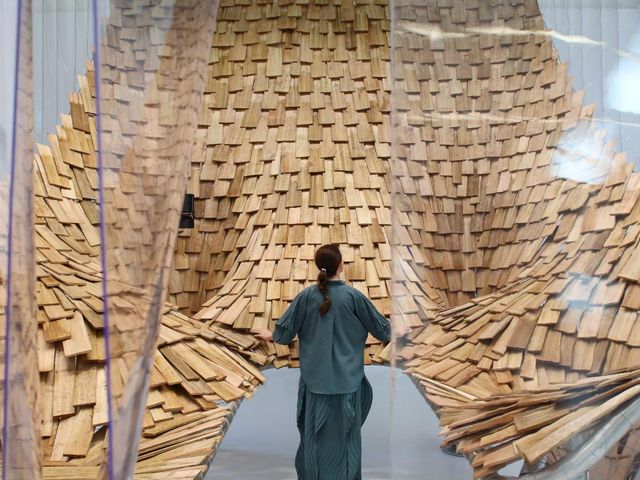
  • A visitor stands inside a sweeping, curved landscape of overlapping wooden shingles, seen through translucent hanging curtains

    Dafne's Skin

    Triennale Milano, Milan, Italy · 2025

    An enlarged fragment of skin from the myth of Dafne, made of wooden tiles, whose surface slowly changes under a robotically applied living patina.

    Architecture and Human Augmentation, ETH Zurich, and MAEID · Photo: Zita Oberwalder

  • Looking up into a cupola of ruffled, translucent plastic layers in pink, blue and purple, printed as hollow tubular beads

    Gelateria Mulegns

    Mulegns, Switzerland · 2025

    An ice cream shop next to Tor Alva, under a cupola robotically printed from recycled plastic: 250 square metres that weigh less than a tonne.

    MAS ETH DFAB and Digital Building Technologies, ETH Zurich · Photo: Stefan Kaiser

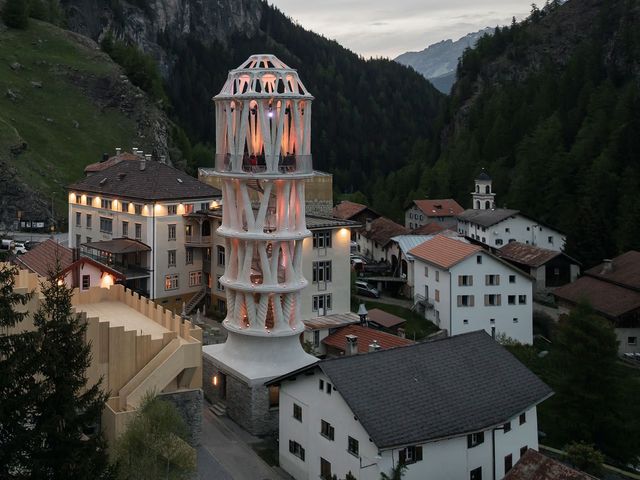
  • A tall white tower of branching printed concrete columns, lit from within at dusk, rising between houses in a mountain village

    Tor Alva

    Mulegns, Switzerland · 2025

    A 30-metre white tower whose load-bearing columns were 3D printed in concrete, with the reinforcement placed by a second robot during printing.

    Digital Building Technologies, ETH Zurich · Photo: Benjamin Hofer / Nova Fundaziun Origen

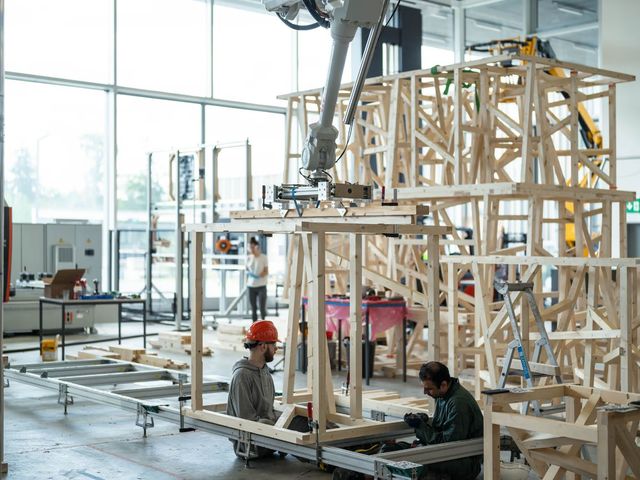
  • Two researchers working beneath a robot arm that holds a timber frame module in place, with finished modules stacked behind them in a laboratory

    Caschlatsch

    Disentis/Mustér, Switzerland · 2024

    A climbable three-storey tower of 2000 timber beams, built by students and robots together in twenty weeks from first sketch.

    Gramazio Kohler Research and MAS ETH DFAB, ETH Zurich

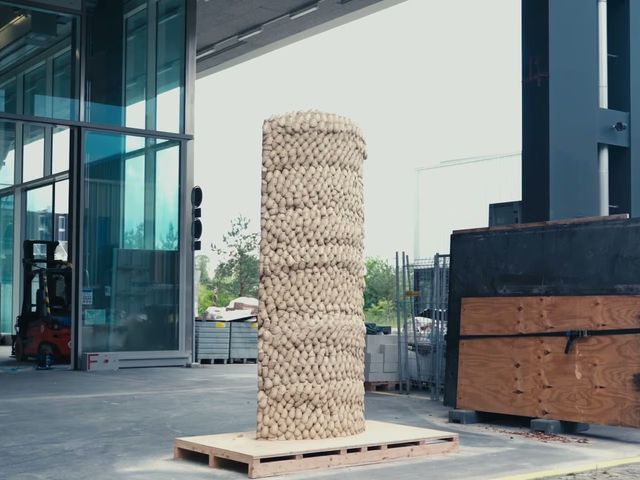
  • A column built from thousands of compressed earth portions standing on a pallet outside a laboratory hall

    Impact Printing

    ETH Zurich, Switzerland · 2024

    A robot shoots portions of earth at high speed, building walls and columns layer after layer without cement and without waiting for the material to set.

    Gramazio Kohler Research, ETH Zurich

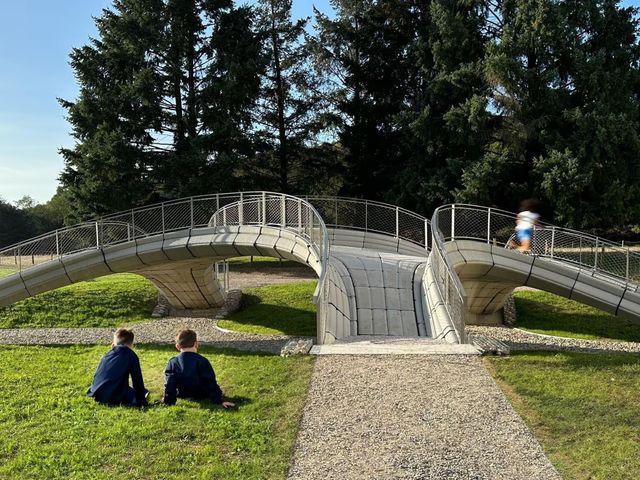
  • Two people sitting on the grass in front of a curving concrete footbridge with steel railings

    Phoenix

    Holcim Innovation Center, Lyon, France · 2023

    Striatus 2.0. A permanent footbridge of 3D-printed concrete blocks, assembled without mortar or reinforcement.

    Block Research Group, ETH Zurich, with ZHA CODE

In their words

At MESH, we create robotic solutions for rebar/construction industry. The COMPAS framework provides us with a powerful platform for developing our custom geometry processing tools and a seamless transition with our robotic fabrication processes.
Mattis KohMesh.ch
COMPAS distills many years of leading academic research into a robust framework tailored for computational design and robotics. Its software-agnostic approach makes it especially well-suited for digital fabrication pipelines that demand adaptability and precision. COMPAS brings together deep research and practical tools for robotics and digital fabrication.
Jelle FeringaTerrestrial

Using COMPAS in research or practice? Tell us what you built with it. With your permission, it could appear here.

Share your story

Support & Expertise

From community help to professional expertise and specialized teams, support is always available to help you integrate COMPAS into real projects.

  • Community Forum
    Open discussions, examples, and help from practitioners and researchers worldwide.
  • Official Documentation
    Detailed guides, tutorials, and reference materials across the entire ecosystem.
  • Education & Research Groups
    COMPAS is developed and used across leading research labs, offering deep domain expertise.
  • Workshops & Training
    Customizable learning programs for teams, from introductory sessions to advanced computational workflows.
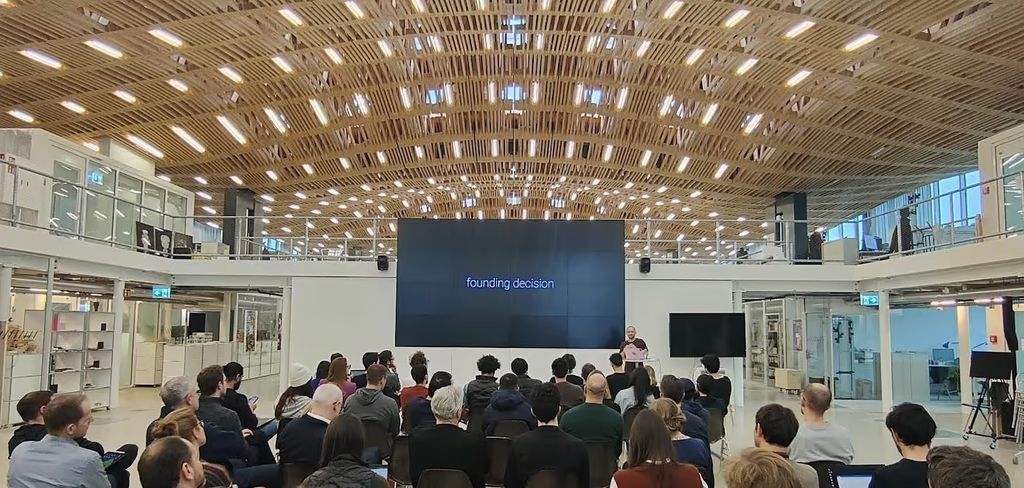
An audience under a timber roof listening to a talk, a screen reading “founding decision”
COMPAS Developer Day.

Join the Association

COMPAS is maintained by the COMPAS Association, an independent public benefit organisation. Membership fees fund the infrastructure and the maintenance, and keep the core library under a permissive licence.

Founding sponsor

Gold and Silver sponsorship is open. Become a sponsor